



How a Deck Footing Is Actually Made — And What Most People Get Wrong
Welcome back to Digging Deeper with The Post Hole Company!
If you’ve spent any time searching the internet for information on deck footings, you’ve almost certainly come across some bad advice. We see it constantly — homeowners who read something online, tried to act on it, and ended up with a failed inspection, a footing that moved, or a deck builder who had to start over from scratch.
So today we’re going to set the record straight. We’re going to explain exactly how a proper deck footing is made in Ontario, why a sonotube is not optional, and how the bell base that gives a footing its strength is actually created — because it is not what most people think.
First: What Is a Deck Footing Trying to Do?
A deck footing has one job — transfer the load of the deck, the people on it, and everything sitting on top of it (furniture, a hot tub, a foot of wet snow in February) down through the soil to stable ground below the frost line.
In our service area across Mississauga, Burlington, Hamilton, Brampton, and the wider GTA, the frost line sits at 2½ feet. That means the ground can freeze solid to a depth of 2½ feet in a hard Ontario winter. Anything anchored in frozen ground gets pushed up as the frost expands, and pulled back as it thaws — a process called frost heave. If your footing is above the frost line, your deck moves with the seasons. That means cracked ledger connections, popped decking boards, and a structure that is slowly working itself apart.
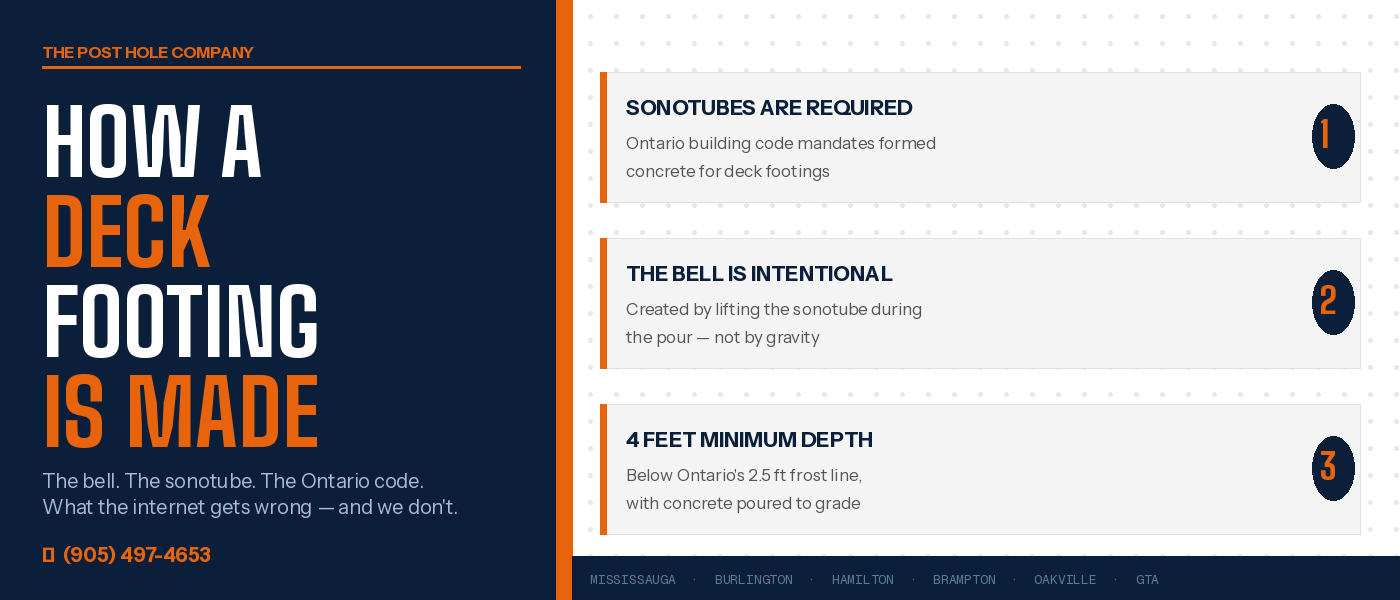
This is why we dig deck footings to a minimum of 4 feet — the base of the concrete sits well below any frost movement, in stable ground that doesn’t shift.
Why Ontario Requires Sonotubes
Here’s the part the internet consistently gets wrong.
A sonotube — a cylindrical cardboard forming tube — is not a suggestion, a convenience, or a preference. Ontario’s building code requires formed concrete for deck footings. The sonotube is the form. Without it, you don’t have a code-compliant footing, and you won’t get a building permit signed off.
This matters for a few reasons beyond just passing inspection:
Formed concrete has a defined, consistent shape. When you drill a hole and simply pour concrete in without a form, the concrete fills whatever irregular shape the drilled hole left behind. Loose soil falls in from the sides. The bearing surface at the base is inconsistent and uncontrolled. You have no idea what you actually built.
A sonotube gives the footing structural integrity from top to bottom. The concrete cures inside a clean cylinder, producing a column with predictable strength and consistent diameter — the kind of footing a deck builder can actually build on with confidence.
Inspectors need to see it done correctly. If your municipality requires a footing inspection before the concrete is poured — and many do — the inspector is looking for a clean, properly drilled hole of the correct depth and diameter, ready to receive a formed pour. They are not looking for an open hole waiting to receive unformed concrete.
Read more about sonotube sizing and why getting the diameter right matters in our post on Sonotube Sizing.
The Bell Base — How It's Actually Made
This is the part that genuinely surprises most people, including homeowners who’ve read a lot about this topic.
You’ll often hear that a deck footing has a “bell base” — a wider, flared section at the bottom of the concrete column that increases the bearing area against stable soil. More bearing area means more resistance to the load pushing down from above. This is correct and important.
What most people don’t understand is how that bell is created.
It is not created by pouring concrete into a hole and letting it spread on its own. That’s not how concrete works in a drilled hole.
Here’s what actually happens:
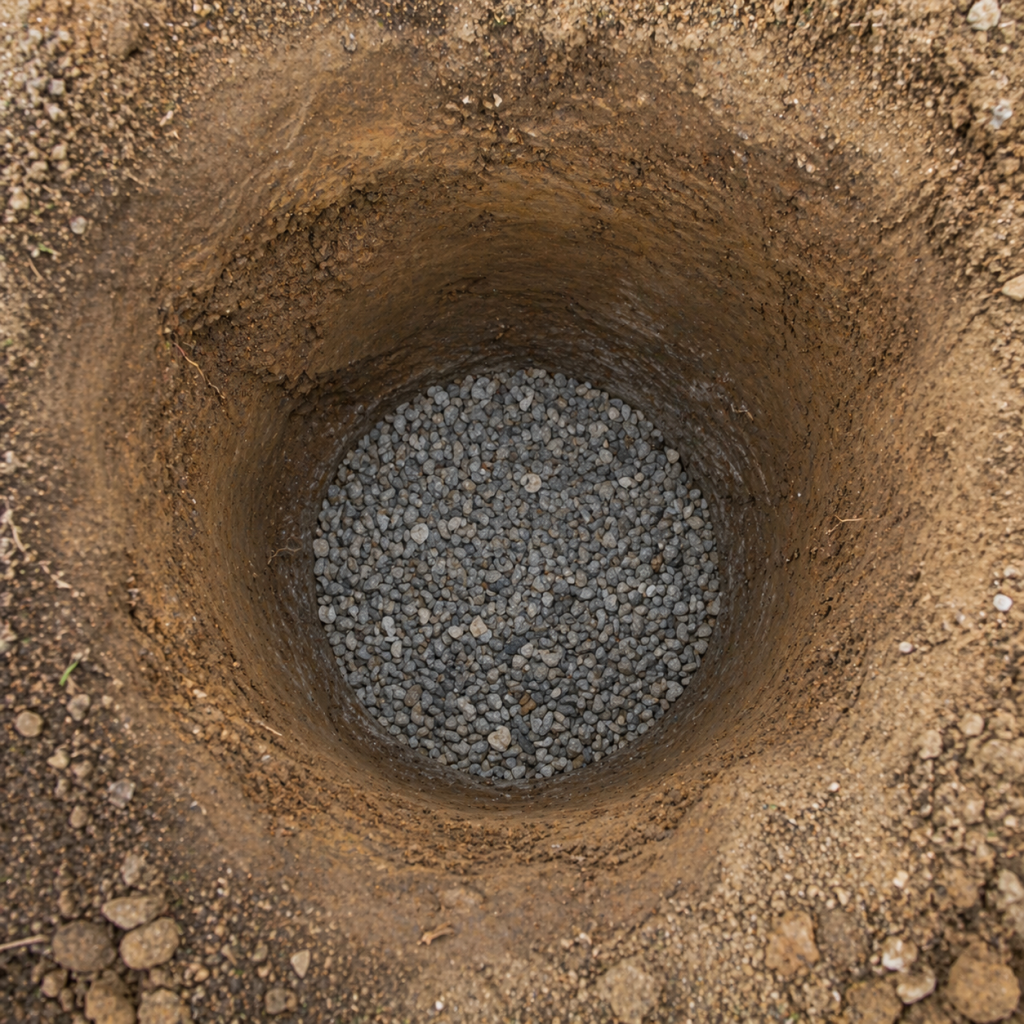
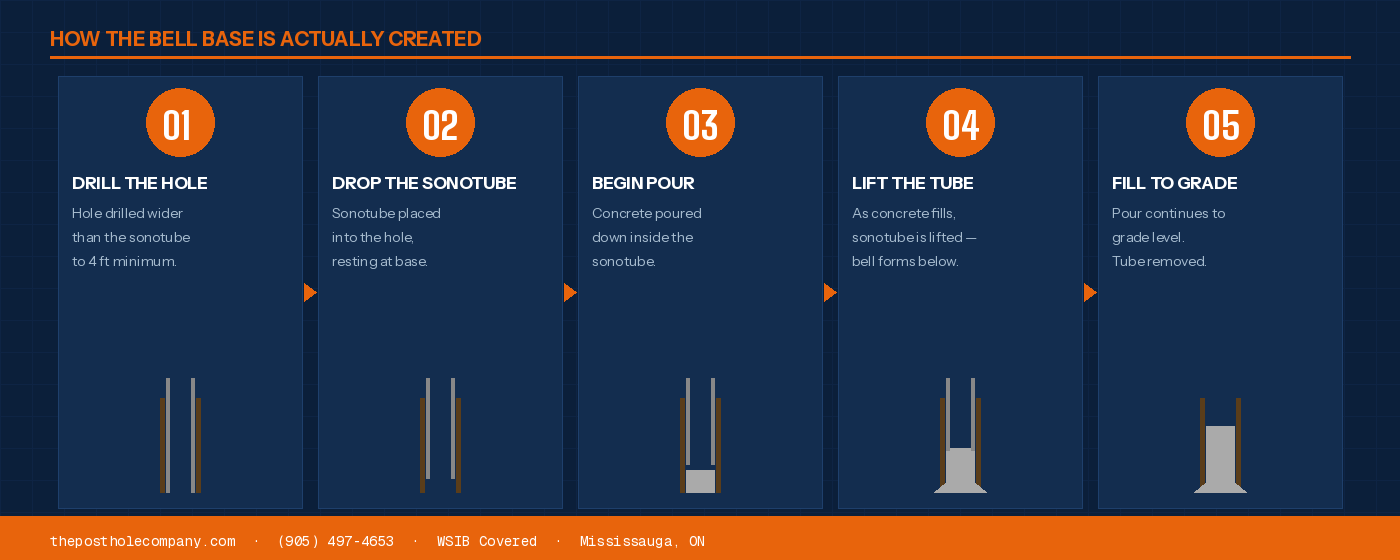
Step 1 — Drill the hole. We drill the hole wider than the sonotube diameter, to a minimum of 4 feet deep. The extra width at the base is what gives the bell room to form.
Step 2 — Drop the sonotube. The sonotube is placed into the hole, sitting down near the base.
Step 3 — Begin the pour. Concrete is poured down inside the sonotube.
Step 4 — Lift the tube. As the concrete fills and begins to build up, we lift the sonotube upward. As the tube rises, the wet concrete at the base is freed from the form and spreads out into the wider space drilled at the bottom of the hole. That spreading concrete — released from the tube as it’s lifted — is what creates the bell. It’s a deliberate, controlled technique, not a happy accident.
Step 5 — Fill to grade. The pour continues as the sonotube rises, filling the column to grade level. The tube is removed. The result is a concrete footing with a solid cylindrical column and a belled foot anchored into stable ground below the frost line.
This is why the skill of the crew pouring the concrete matters. The lift has to happen at the right pace, with the right concrete consistency, to get a proper bell. Rush it or get the mix wrong and you don’t get the bell you think you’re getting.
What the Internet Gets Wrong
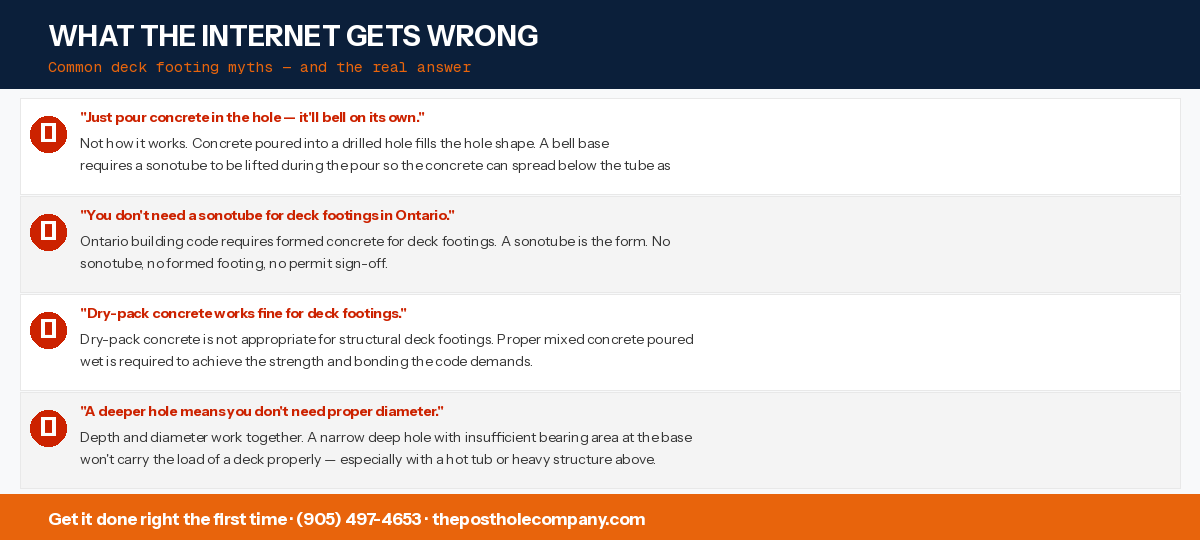
“Just pour concrete in the hole — it’ll bell on its own.” No. Concrete poured into a drilled hole fills the hole shape. It does not spontaneously spread into a bell at the base. The bell is created by the sonotube lift technique described above. This is one of the most persistent myths in the DIY deck building world and it leads to footings that look fine from above but have no meaningful bearing area at the base.
“You don’t need a sonotube for deck footings in Ontario.” You do. Ontario building code requires formed concrete for structural deck footings. A sonotube is the form. No exceptions for residential decks requiring a permit — which means any deck more than 600mm above grade.
“Dry-pack concrete works fine for deck footings.” It does not. Structural deck footings require properly mixed, poured wet concrete. Dry-pack techniques are not appropriate for this application and will not satisfy a building inspector.
“Deeper is always better — you can skip worrying about diameter.” Depth and diameter work together. A footing that is deep enough but too narrow lacks sufficient bearing area to carry the load properly — especially as loads increase with larger decks, elevated structures, or heavy additions like hot tubs and outdoor kitchens. Both dimensions matter and both need to be specified correctly for your build.
What This Means When You Book Us
When you call The Post Hole Company for deck footings, here’s what you should have ready:
The hole spec from your deck builder. Your deck builder knows what they’re building and what they need to fasten to. They’ll give you a diameter and a depth. Common specs are 10-inch, 12-inch, or 14-inch diameter sonotubes at 4 feet deep, but this varies with the deck design and load requirements. Get that spec before you call us.
Your permit and inspection timing. If your municipality requires a footing inspection before the pour — call your local building department to confirm — you’ll need to coordinate the inspection booking so the inspector can see the open holes before we pour. We can advise on how to sequence this so your build doesn’t stall.
Your locate status. We call Ontario One Call before every dig. Locates take 5 to 7 business days. Factor that into your project timeline. More on why locates matter in our post on The Importance of Locating Utility Lines.
Whether you have private utilities. Ontario One Call only marks public utilities. If you have irrigation, pool lines, power to a shed, or a gas line for an outdoor BBQ, you’ll also need a private locate. Read more in our post on Private vs Public Locates.
Our Job vs. Your Deck Builder's Job
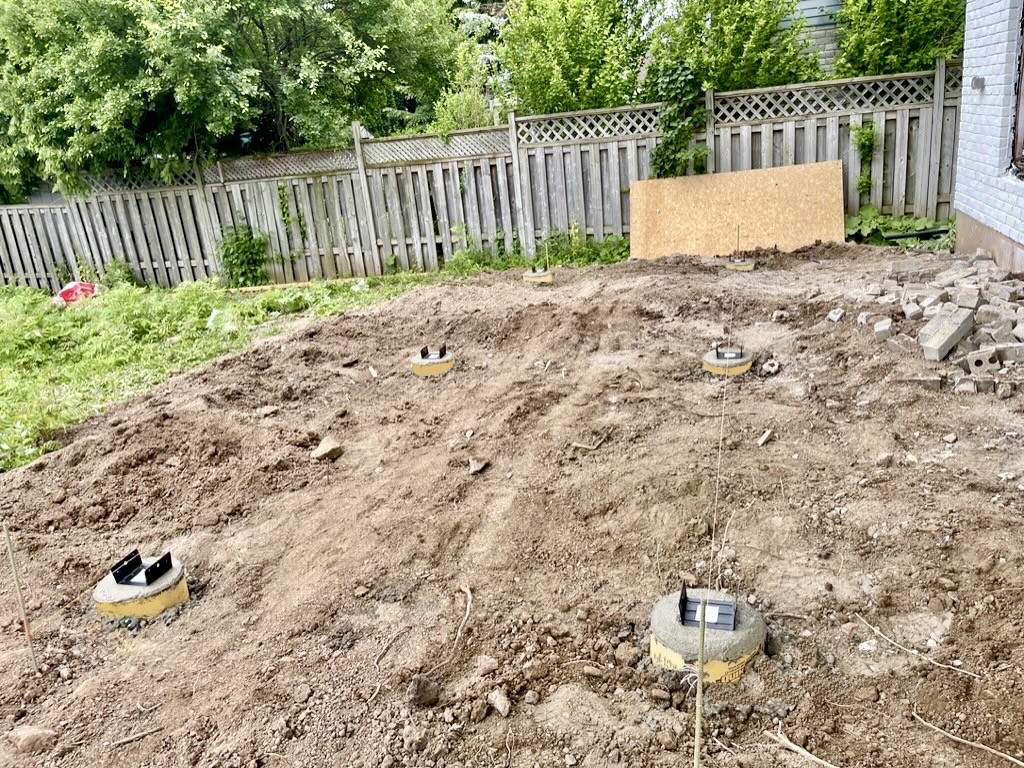
At The Post Hole Company, we handle the hole and the concrete. We drill to the correct depth and diameter, execute the pour including the bell base lift technique, and ensure the footing is code-compliant and ready for your deck builder to build on.
The posts, beams, framing, and decking are your deck builder’s work. The two scopes need to be sequenced correctly — footings in and cured before the framing starts — and the spec needs to match between us and your deck builder. When those two things are lined up, everything flows cleanly.
If you’re not sure how to coordinate between us and your deck builder, call us. We do this every day across the GTA and we can walk you through the sequencing.
Ready to Book?
We dig deck footings for residential and commercial clients across Mississauga, Burlington, Hamilton, Brampton, Oakville, Scarborough, and the greater GTA. We bring the equipment, the concrete, and 16-plus years of knowing exactly how to execute a footing that will hold.
📞 Call us at (905) 497-4653 💬 Message us on WhatsApp 🌐 Request a quote online 💲 See our pricing