



Do You Need Gravel Under Deck Footings?
No.
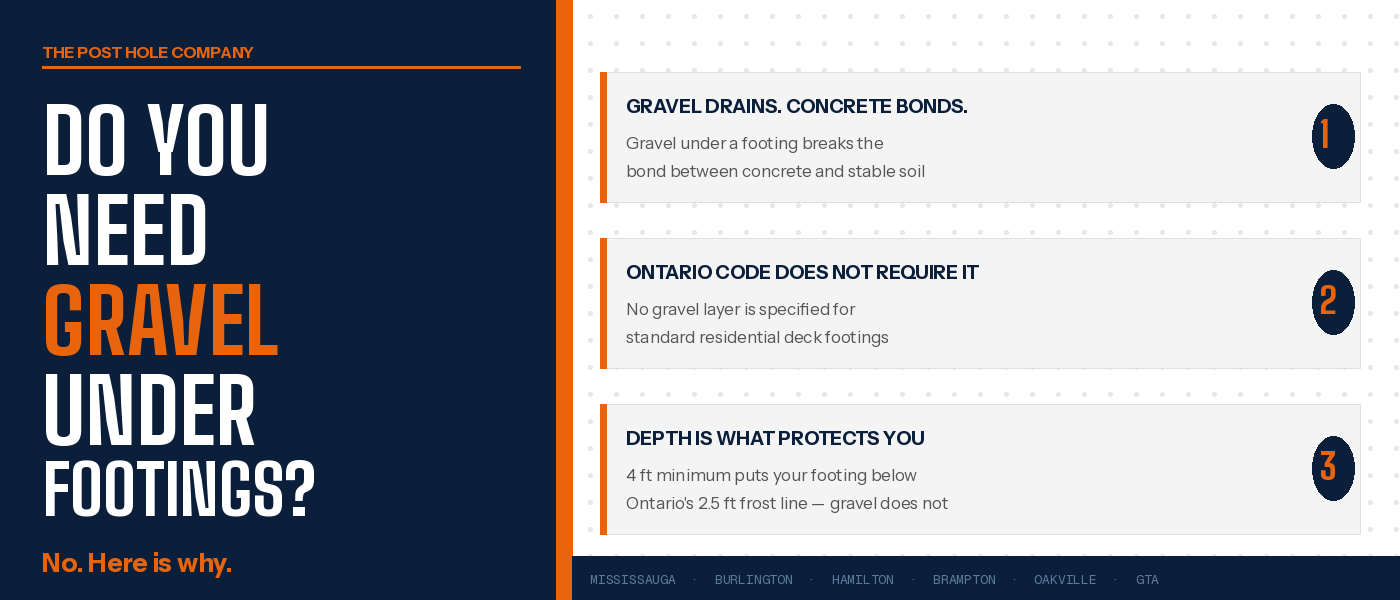
That’s the short answer. You do not need gravel under a deck footing in Ontario, and in fact putting gravel there works directly against what a footing is trying to do.
But this question comes up constantly — from homeowners, from DIYers, and occasionally from people who’ve watched one too many YouTube videos filmed in a different province or a different country with different soil, different codes, and different requirements than what we deal with here in the GTA.
So let’s break it down properly. Where does the gravel myth come from, why it doesn’t apply to deck footings, and what actually matters when it comes to making a footing that holds.
Where the Gravel Idea Comes From
Gravel is genuinely useful in construction — just not here. Here’s where the confusion typically starts:
Drainage applications. Gravel drains water. That’s its primary structural value. Around weeping tile, under interlocking stone, in French drains — gravel is excellent because it allows water to move through and away from a structure. People who understand this correctly sometimes over-apply the principle and assume gravel must be good under footings too, because wet soil is bad for foundations. The logic sounds reasonable. It’s still wrong.
Concrete slab construction. Poured concrete patios and garage floors are often placed over a compacted gravel base. This is a legitimate technique — but it applies to slabs sitting at or near grade, not to deep structural footings. The applications are completely different.
Recommendations from other climates. A lot of online deck-building content comes from the United States, where frost depths vary enormously by region. In parts of the southern US, the frost depth is negligible and the soil profile is completely different from GTA clay. What works in Georgia does not necessarily apply in Mississauga.
Why Gravel Under a Footing Is the Wrong Call
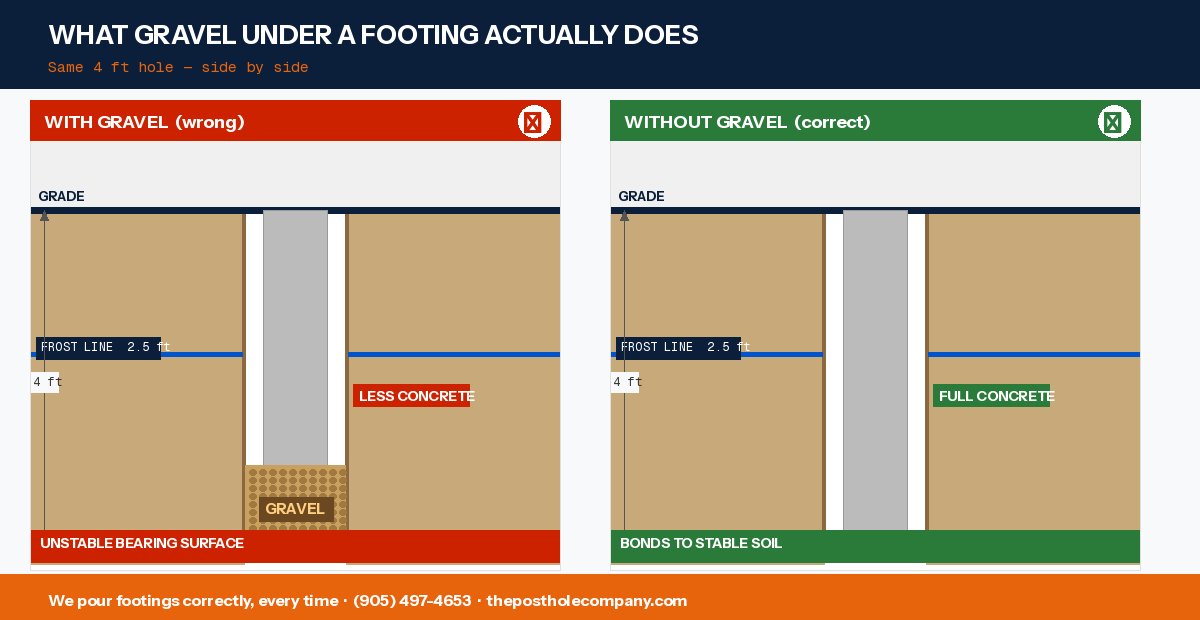
A deck footing works by transferring load — the weight of the deck, everyone on it, everything sitting on top — down through a column of concrete to stable soil below the frost line. That direct contact between concrete and stable soil is the whole point.
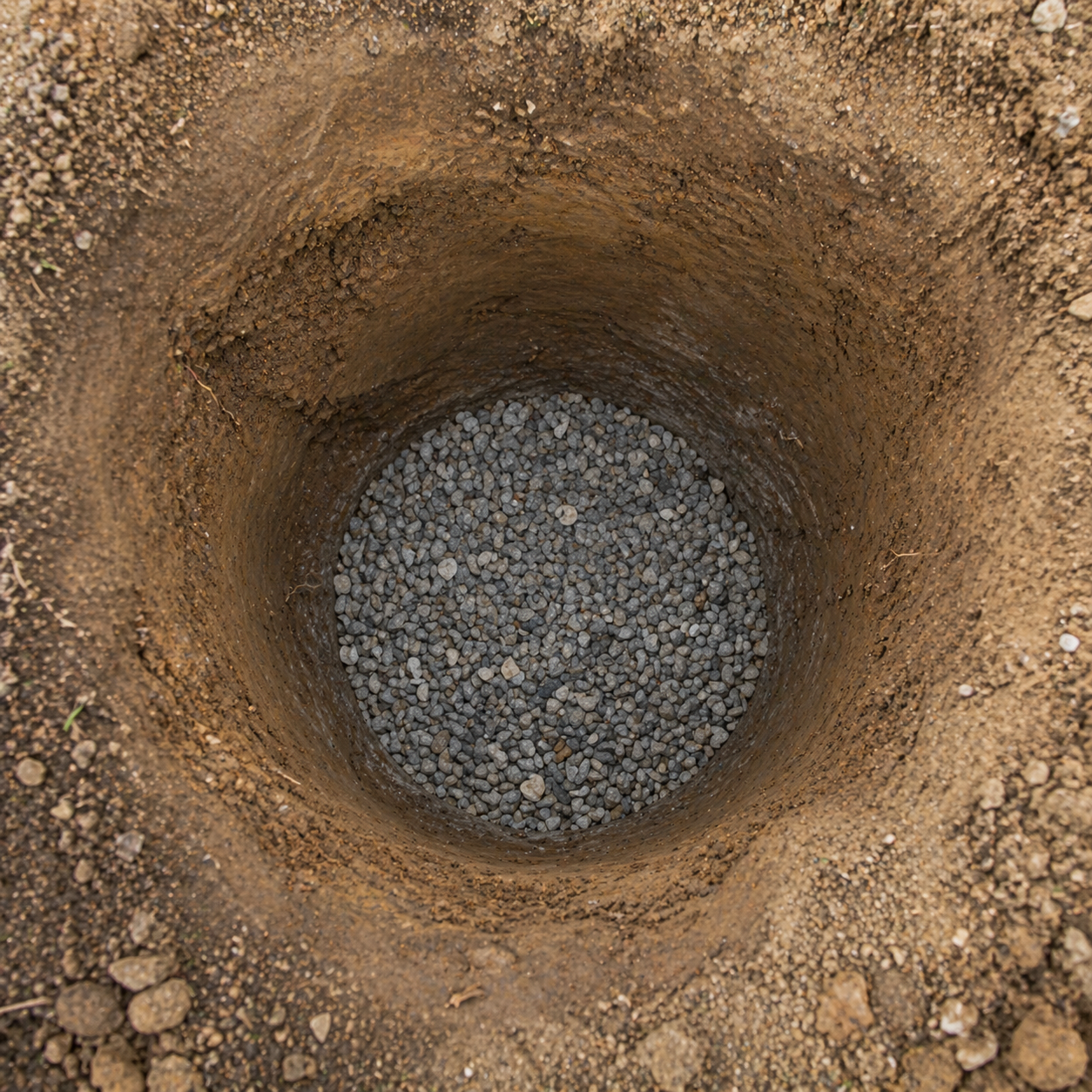
Put gravel between the concrete and the soil and here is what happens:
You get less concrete in the hole. Gravel takes up space at the base of the hole. That means your concrete column is shorter than it should be for a 4-foot hole. You’re paying for a 4-foot dig and getting a shorter footing because the bottom portion is gravel, not concrete. That’s not a good trade.
You’ve broken the bond. Concrete poured directly onto stable, undisturbed soil develops a bond with the ground that contributes to the footing’s resistance to movement. A layer of loose gravel eliminates that bond entirely. The footing is now sitting on a compressible layer — which is the opposite of what you want.
Gravel is not a stable bearing surface — even when tamped. Some people argue that if you tamp the gravel firmly enough, it’s stable. It isn’t. Gravel under load will shift over time. A concrete footing bearing directly on undisturbed native soil is a completely different proposition than one sitting on a layer of loose stone, regardless of how well that stone was compacted.
You’ve introduced drainage in exactly the wrong place. Gravel drains — so water at the base of your footing hole now pools in the gravel bed, freezing in winter and potentially causing the very frost movement you dug 4 feet to avoid.
Going deeper to compensate costs you more. If gravel at the base means your concrete doesn’t reach stable soil, the fix is digging deeper. But deeper holes mean harder digging conditions — harder soil, more wear on equipment, more time on site, higher cost per hole. This is not a rabbit hole you want to go down because gravel was added where it shouldn’t have been.
Ontario building code does not require it. There is no gravel layer specified for standard residential deck footings in Ontario. If it were beneficial, it would be in the code. It isn’t.
What Actually Protects a Deck Footing in Ontario
Depth. That’s it.
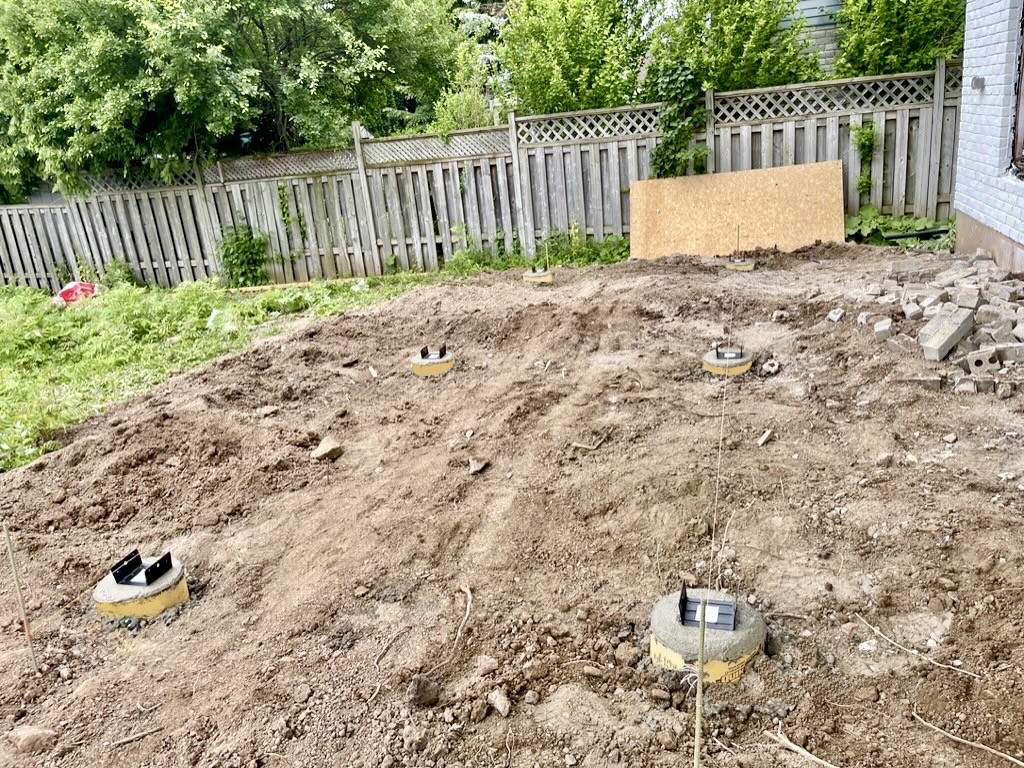
Our frost line in the GTA sits at 2.5 feet. The ground can freeze solid to that depth in a hard Ontario winter. We dig deck footings to a minimum of 4 feet — the base of the concrete sits well below frost movement, bearing on stable soil that doesn’t shift with the seasons.
The sonotube is the form that holds the concrete in a clean, consistent cylinder from the base to grade. The concrete cures inside that form as a solid column, bonded to stable soil at the bottom. That is what keeps your deck level year after year — not drainage material, not gravel, not anything else at the base of the hole.
Read more about how a properly formed Ontario deck footing is made in our post on How a Deck Footing Is Actually Made.
Where Gravel Does and Doesn't Belong
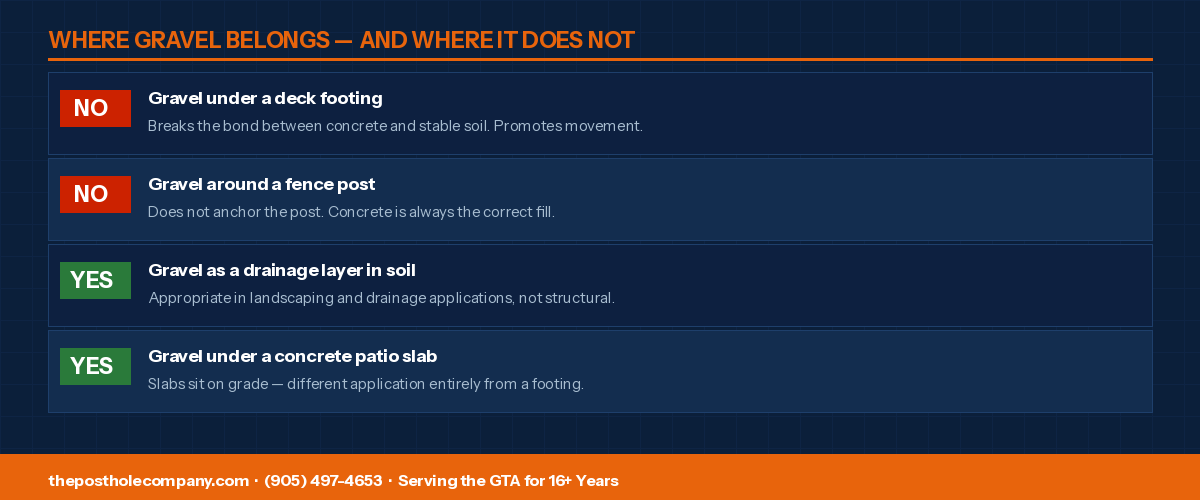
Gravel does not belong under a structural deck footing. It reduces the effective concrete depth, breaks the concrete-to-soil bond, introduces compressibility, and is not required by Ontario building code.
Gravel does not belong as fill around a fence post. Concrete is the correct anchor material. We cover this in our post on what happens when you install fence posts without concrete.
Gravel does belong as a drainage layer in landscaping — around weeping tile, under interlock, in French drain systems — where water management is the goal and structural load transfer is not.
Gravel does belong under a poured concrete patio slab or garage floor, as a sub-base for a slab sitting at or near grade. Completely different application from a deep structural footing.
The distinction is simple: if the job is to carry structural load to stable ground, you want concrete bearing directly on soil. If the job is to drain water, gravel is useful. Don’t mix up the applications.
“But I Saw It Done That Way Online”
We know. There is an enormous amount of deck building content out there — some of it excellent, a lot of it filmed in different climates with different codes and different soil, and some of it just wrong. Ontario’s building code exists for a reason, and when in doubt the right move is to call your local building department and ask. Or call us — we’ve been digging footings across the GTA for over 16 years.
What We Do on Every Footing Job
When The Post Hole Company digs and pours your deck footings:
- Hole drilled to the correct diameter and 4-foot minimum depth
- Sonotube placed and concrete poured correctly — no gravel layer, ever
- Concrete bears directly on stable, undisturbed soil below the frost line
- Post anchor set before the concrete cures if required by your deck builder
- Ontario One Call locate completed before every dig — no exceptions
Ready to Book?
We dig and pour deck footings for residential and commercial clients across Mississauga, Burlington, Hamilton, Brampton, Oakville, Scarborough, and the greater GTA.
📞 Call us at (905) 497-4653 💬 Message us on WhatsApp 🌐 Request a quote online 💲 See our pricing