




Bollard Supply & Installation in Ontario: What You Need to Know
Welcome back to Digging Deeper with The Post Hole Company!
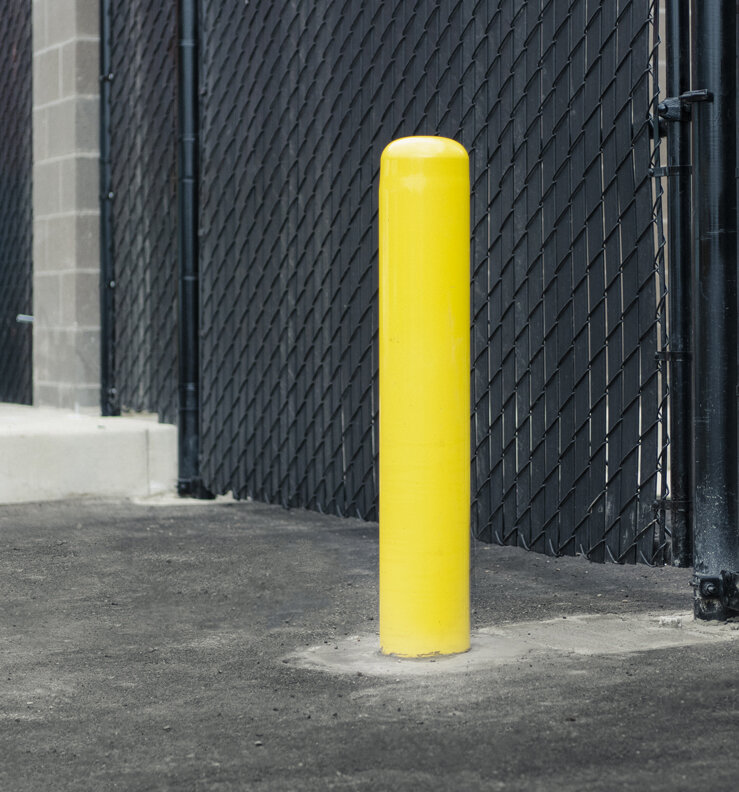
Bollards are everywhere once you start noticing them. The steel post at the end of your driveway stopping cars from cutting the corner. The cast iron pillars outside a storefront downtown. The removable post blocking a laneway. The yellow-painted barrier protecting a gas metre on the side of a building.
They look simple. But installing them properly — at the right depth, perfectly plumb, in the right concrete, in the right location — is a job that requires the same discipline as any post hole work. Maybe more, because bollards are often load-bearing in a way fence posts are not. When a vehicle hits a properly installed bollard, that bollard needs to win.
At The Post Hole Company, we supply and install bollards for residential and commercial clients across Mississauga, Burlington, Hamilton, Brampton, Oakville, and the wider GTA. This guide covers everything you need to know before you book.
What Is a Bollard, and What Is It Actually For?
A bollard is a short, sturdy vertical post installed in or on the ground to control or direct vehicle and pedestrian traffic. The name goes back centuries — originally referring to the thick wooden or iron posts on a dock used to tie off ships. Today the word covers a wide range of products with very different purposes:
Vehicle access control. This is the most common residential use. A bollard at the end of a driveway, across a laneway, or at the edge of a parking area stops vehicles from going where they shouldn’t.
Asset and building protection. Bollards installed in front of building corners, utility metres, storefronts, and loading docks protect the structure from accidental vehicle impact. In commercial settings this is often a building code or insurance requirement.
Pedestrian safety. In plazas, along sidewalks, and at outdoor dining areas, bollards create a physical barrier between vehicle traffic and foot traffic.
Perimeter security. High-security bollards — sometimes called anti-ram bollards — are engineered to stop vehicles deliberately driven at high speed into a protected area. These are a different category of product entirely and are typically specified by engineers for government or critical infrastructure installations.
For most residential and small commercial projects in Ontario, you’re dealing with one of the first three categories above.
Types of Bollards — Which One Do You Need?
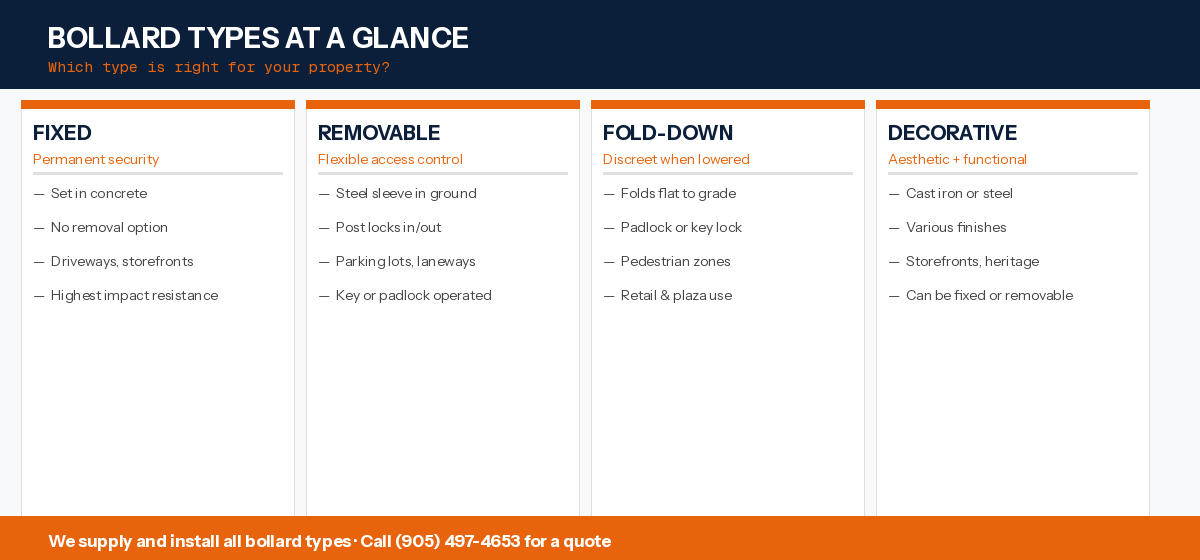
Understanding the differences between bollard types upfront will save you time, money, and the frustration of having to redo the work later.
Fixed Bollards
Fixed bollards are permanently set in concrete and are not designed to be removed. They provide the highest level of impact resistance for a given product and are the right choice when the goal is permanent protection — building corners, gas metres, utility equipment, the end of a driveway where you want a permanent barrier.
Because they’re set in concrete, removal later is the same exercise as removing a fence post footing: a real dig, a real mess, and a real job. If there’s any chance you’ll want flexibility later, think carefully before going fixed.
Removable Bollards
Removable bollards use a steel sleeve system. The sleeve is set in concrete permanently in the ground, and the bollard itself locks into the sleeve. When access is needed — for a delivery truck, for moving equipment, for seasonal use — the bollard is unlocked and lifted out. When access needs to be blocked again, the bollard drops back in and locks.
This is the most popular choice for driveways, parking areas, and commercial lots where occasional access is needed but regular vehicle intrusion is not welcome.
The sleeve needs to be set at the correct depth and perfectly plumb. If the sleeve goes in crooked, the bollard will sit crooked, and it’ll bind on the way in and out. This is one of those installations that looks easy and isn’t.
Fold-Down Bollards
Fold-down bollards fold flat to grade level when lowered. They’re popular in pedestrian zones, retail plazas, and areas where a full above-grade post would be a visual obstruction or a trip hazard when not in use. They lock upright when protection is needed and fold down and padlock flat when the area needs to be open.
Decorative Bollards
Decorative bollards prioritize appearance alongside function. Cast iron and powder-coated steel bollards in heritage styles are commonly used at storefronts, along heritage streetscapes, in commercial plazas, and at the entrance to properties where curb appeal matters. They can be fixed or fitted with removable sleeve systems depending on the application.
Residential vs. Commercial Bollard Installation — What’s Different?
Residential installations are typically smaller in scale — one to four bollards at a driveway entrance, around a garage, or protecting a corner of a property. Access is usually straightforward. The main considerations are bollard type, correct depth, and making sure the locate is done before we dig.
Commercial installations vary enormously. A retail plaza might need a dozen bollards along a storefront. A warehouse loading dock might need heavy-duty protection posts at specific engineering-specified locations. A municipal property might require anti-ram rated bollards with engineer-stamped installation documentation.
For commercial work, we work from your site plan or engineering drawings where applicable. For smaller commercial jobs without drawings, we’ll walk the site with you and confirm locations and product specs before we start.
One important note for commercial clients: bollard placement is often governed by your municipality, your insurance requirements, or your building permit conditions. Before you assume you can put a bollard wherever you want, check with your local building department — particularly for any bollard installation near a public sidewalk, road allowance, or shared property boundary.
How Deep Does a Bollard Need to Be Set?
Depth depends on the bollard type, its diameter, the load it’s expected to take, and the soil conditions.
As a general guideline for standard residential and light commercial bollards in our service area:
- Fixed and removable bollard sleeves are typically set a minimum of 24 to 36 inches deep, with the exact depth depending on the bollard’s diameter and the manufacturer’s specification
- Larger diameter or heavy-duty bollards may require 48 inches or more, particularly in clay or unstable soil
- Anti-ram and security-rated bollards have engineered installation specifications that must be followed exactly — depth, concrete mix, rebar — and we follow those specs to the letter
Our frost line in the GTA is 2½ feet. For any bollard expected to take regular vehicle impact, we want the footing below that frost line so frost heave doesn’t compromise the installation over time.
The Installation Process
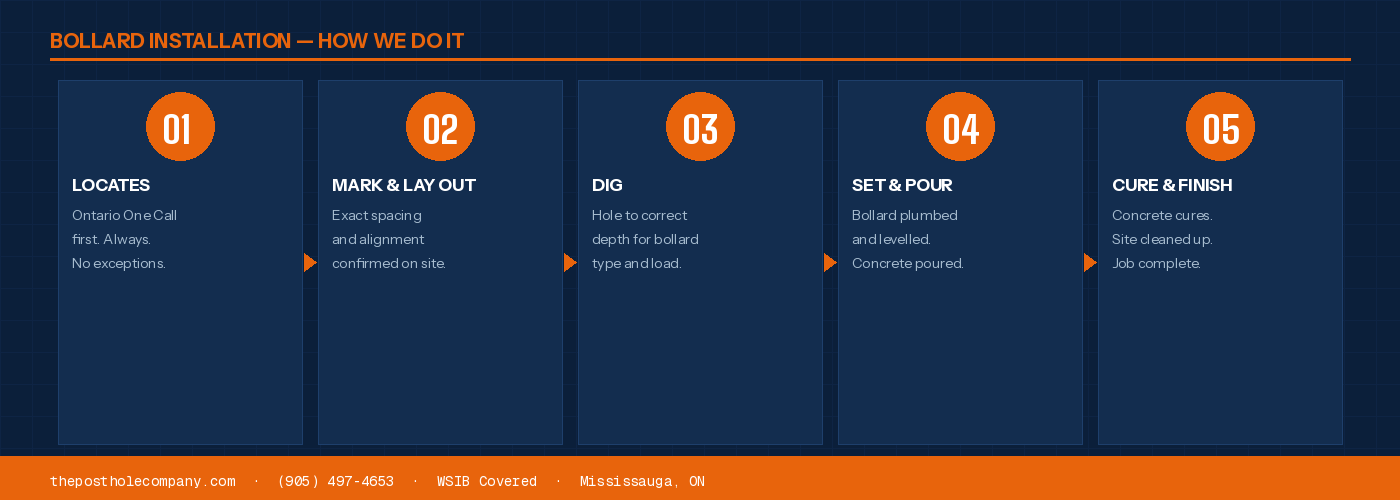
Here’s how a typical bollard installation goes with our crew:
Step 1 — Locates. We call Ontario One Call before anything else. No dig happens without a valid locate, full stop. If you have private utilities — irrigation, pool lines, power to a shed — you’ll need a private locate as well. We can walk you through that process if you’re not sure. More on this in our post on Private vs Public Locates.
Step 2 — Mark and lay out. We confirm exact bollard placement on site with you before we dig. Spacing, alignment, setback from the road or property line — all of this gets confirmed before a single hole is started. Moving a bollard after the concrete cures is the same job as removing one entirely.
Step 3 — Dig. We drill the hole to the correct diameter and depth for the bollard type and expected load. In rocky or clay-heavy GTA soil, this is where the right equipment makes the difference.
Step 4 — Set and pour. The bollard or sleeve is placed in the hole, plumbed, braced, and held in exact position while concrete is poured. We do not rush this step. A bollard that sets up one degree off plumb is a bollard that will bother you every time you look at it — and in the case of a removable sleeve, one that will bind on every insertion and removal.
Step 5 — Cure and clean up. Concrete needs time to cure before the bollard is put into service. We’ll advise you on appropriate cure time based on the product and the weather conditions at the time of installation. We clean up the site before we leave.
We Supply the Bollards Too
Unlike some post hole companies that dig only and leave the product sourcing to you, we supply bollards as part of our service. We stock a range of standard residential and commercial bollards and can source specialty products for larger or more specific commercial applications.
This matters for a few reasons. When we supply the bollard, we know exactly what we’re installing. We know the sleeve dimensions, the required hole diameter, the embedment depth, and the concrete specification the manufacturer calls for. Nothing gets lost in translation between the supplier and the installer because they’re the same company.
If you already have bollards on hand and just need them installed, we can work with that too. Bring us the product specs and we’ll make sure the hole and the installation meet the manufacturer’s requirements.
A Note on Permits
Most standard residential bollard installations — a post at the end of your driveway, protection for a gas metre — don’t require a building permit. However, there are situations where a permit may be needed:
- Installations near a road allowance or public right-of-way
- Commercial installations where bollards are specified as part of a site plan
- Anti-ram or security-rated bollards on regulated or government property
If you’re not sure whether your project requires a permit, call your local municipal building department before you book. It’s a five-minute call that can save a lot of headaches.
Ready to Book?
Whether you need one bollard at the end of your driveway or a commercial installation across an entire storefront, The Post Hole Company has the equipment, the product, and the expertise to do it right.
We serve residential and commercial clients across Mississauga, Burlington, Hamilton, Brampton, Oakville, Scarborough, and the greater GTA.
📞 Call us at (905) 497-4653 💬 Message us on WhatsApp 🌐 Request a quote online 💲 See our pricing