





Welcome back to Digging Deeper with The Post Hole Company!
If you’ve ever had a fence post go soft, lean, or snap off at the base, you’ve probably blamed the rain. Makes sense — wood, water, rot. Seems obvious.
But water alone isn’t what rots fence posts. A piece of driftwood that stays submerged in a lake can last decades. The wood on the hull of a 200-year-old shipwreck is often found remarkably intact. Constant moisture, on its own, doesn’t rot wood nearly as fast as people think.
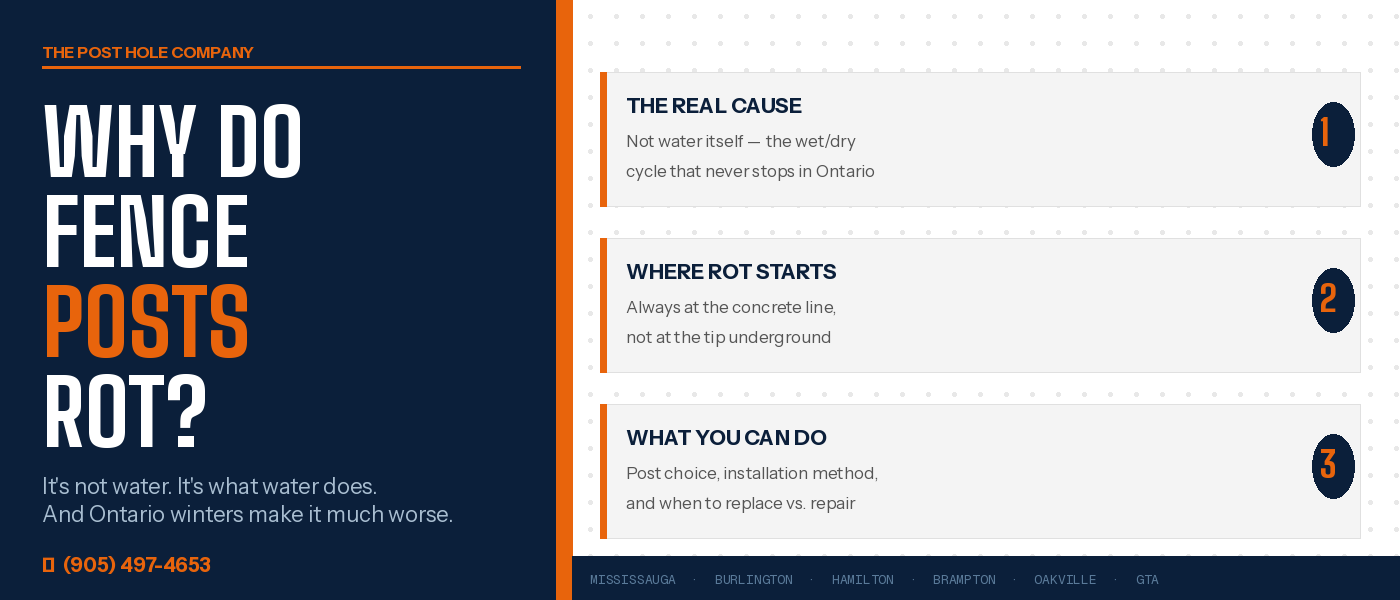
What rots fence posts is the cycle. The wet. The dry. The wet again. Over and over, season after season — and in Ontario, add freeze and thaw on top of that. That is what kills a fence post. And understanding why it happens is the first step to making your next fence last significantly longer.
The Real Mechanism: Expansion and Contraction
Wood is a porous material. When moisture gets in, the wood fibers swell. When it dries out, they contract. Every single cycle of swelling and contracting puts stress on those wood fibers — microscopic tears that accumulate over time, weakening the cellular structure of the post from the inside out.
Think of it like bending a piece of wire back and forth. One bend doesn’t break it. But bend it enough times in the same spot and it snaps. That’s what repeated moisture cycles do to wood grain.
In a wet climate where it rains and dries and rains again — which describes most of Ontario’s spring, summer, and fall — a fence post can go through hundreds of these cycles in a single year. Each one is doing a little damage. The cumulative effect is a post that looks fine from the outside until one day it doesn’t.
Why Ontario Makes It Worse
The GTA and surrounding areas don’t just have wet/dry cycles. They have freeze/thaw cycles layered on top.
Water expands by roughly 9 percent when it freezes. When moisture is trapped inside wood grain and the temperature drops below zero, that expansion doesn’t have anywhere to go — it pushes outward against the wood fibers, creating microcracks. When the temperature rises and the ice melts, those cracks stay. Then more moisture gets in. Then it freezes again.
This is why fence posts in Ontario typically fail faster than fence posts in milder climates. It’s not just rain. It’s rain, then summer heat drying it out, then autumn rain, then winter freeze, then spring thaw. That full cycle in a single year does real damage.
Where Rot Actually Happens
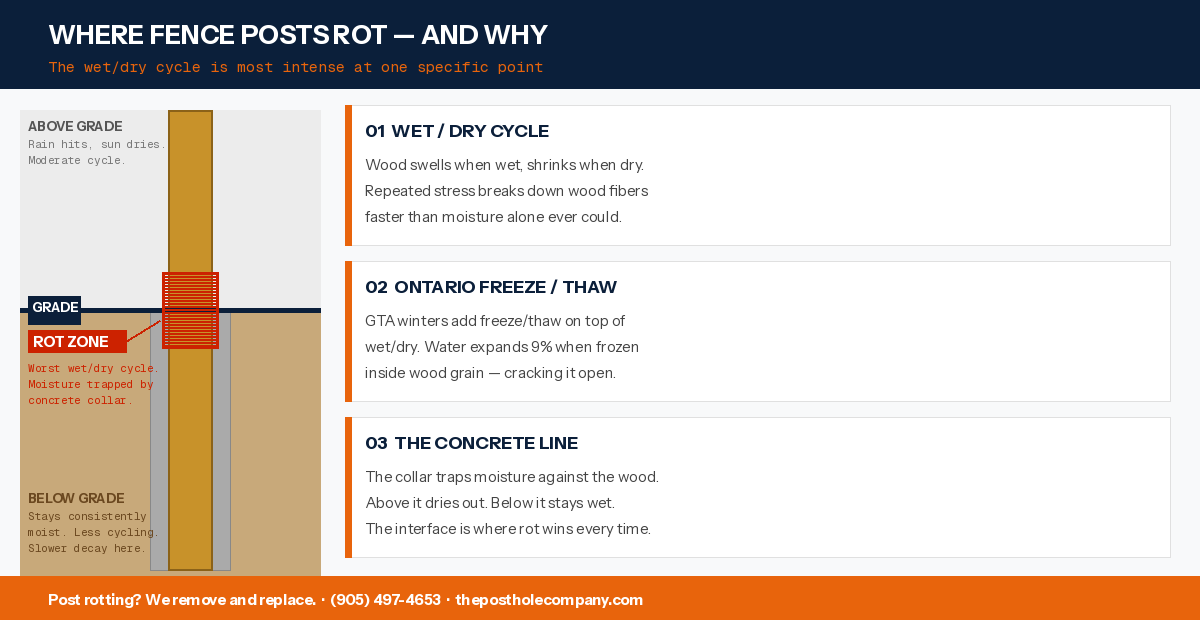
Here is something most homeowners don’t realize: fence post rot almost always starts at the same place — right at the concrete line, where the post transitions from above-grade to below-grade.
Here’s why that specific location is the worst:
Above the concrete line, the post is exposed to the elements — rain hits it, sun dries it. Wet/dry cycles happen, but the post is fully exposed to air so it dries out reasonably well between rain events.
Below the concrete line, the post is surrounded by soil and concrete. It stays consistently moist. Not great for the wood, but at least it’s not cycling dramatically between wet and dry.
At the concrete line — that narrow zone where the post transitions from buried to exposed — you get the worst of both worlds. Moisture wicks up from the soil and gets trapped against the wood by the concrete. The sun dries out the few inches above it. That interface zone cycles harder than anywhere else on the post, and it’s also the spot where the concrete collar traps standing water against the wood if it wasn’t poured correctly.
This is why posts almost always rot at grade level, not at the tip underground. It’s not depth that kills them — it’s the transition zone.
What You Can Do to Slow It Down
You can’t stop wood from cycling with moisture and temperature. But you can make smarter choices that slow the process significantly.
Choose the right post material. Pressure-treated lumber (ACQ or similar) is the standard for fence posts in Ontario for a reason — the treatment process forces preservatives deep into the wood fibers, making them significantly more resistant to the fungi and bacteria that accelerate decay. The treatment is rated by retention level: UC4A and UC4B are the ratings you want for ground contact applications. When you’re buying posts, look for those stamps on the wood.
Avoid end grain exposure at the concrete line. End grain — the cut face at the bottom of a post — absorbs moisture far faster than side grain. If a post is cut and that fresh end is sitting at or near grade where moisture concentrates, it accelerates decay significantly. Some installers seal the end grain before setting the post. It’s a small step that can extend post life meaningfully.
Don’t set posts in gravel. Gravel does not anchor a post, and it does nothing to protect against rot. In fact, a post set in gravel has more moisture contact without the stability of concrete — the worst of both worlds. Concrete is the correct anchor material, full stop. Read more in our post on What Happens When You Install Fence Posts Without Concrete.
Get the depth right. A post set at the correct depth — 3.5 feet in our service area, below Ontario’s 2.5 ft frost line — sits in consistently moist, thermally stable soil at its base. The frost heave that cracks the concrete collar and opens up gaps at the grade line is far more likely to happen to a shallow post than a properly deep one. Depth isn’t just about stability. It’s also about putting the base of the post in conditions that don’t cycle as dramatically.
Don’t let soil or mulch pile up against the post. Grade should slope away from the post, not toward it. Anything that traps moisture against the wood at or above the concrete line accelerates rot. Keep mulch, soil, and garden beds clear of the post base.
The Gimmicks: Post Sleeves, Tar, and Other “Rot Prevention” Products
Walk into any big box store and you’ll find no shortage of products promising to extend the life of your fence posts. Post sleeves. Brush-on tar coatings. Rubber boots. Plastic wraps. They all make the same basic claim — seal the wood from moisture and you stop the rot.
You might be thinking — if the wet/dry cycle is the enemy, shouldn’t we try to eliminate the moisture entirely? That’s exactly what these products claim to do.
Here’s why it doesn’t work: you can’t seal wood permanently. And when the seal eventually fails — and it always does — you’ve often made the situation worse, not better.
Post sleeves are plastic or composite tubes that slip over the bottom of a wooden post before it’s set. The theory is that the sleeve acts as a barrier between the wood and the soil. In practice, moisture still finds its way in — through the top of the sleeve, through any gap in the fit, and through condensation that forms on the inside of the sleeve when temperatures swing. Once moisture gets inside a sealed sleeve, it has nowhere to go. It sits trapped against the wood, and the wet/dry cycle that causes rot in the first place is now happening in a confined, poorly ventilated space. You’ve essentially created a terrarium for rot at the exact spot where rot is most likely to start.
Painting or brushing the post with tar is an old-school technique that sounds sensible — seal the end grain and the below-grade section with a waterproof coating and keep the moisture out. The reality is that tar coatings crack and peel over time, especially through Ontario’s freeze/thaw cycles. Once the coating cracks, moisture gets in through the breach — and now it’s trapped beneath a coating that prevents it from drying out. You’ve turned an exposed surface into a sealed pocket of moisture. Not an improvement.
The honest answer is that no surface treatment reliably extends fence post life in a meaningful way in a climate like ours. What actually works is using properly rated pressure-treated lumber to start with, setting it correctly to depth in concrete, and keeping the grade clear of the post base. Those three things will outlast any sleeve or coating every time.
For a full breakdown of why concrete beats foam and why most alternative post-setting products don’t hold up in Ontario conditions, read our post on Concrete vs. Post Hole Foam: Which Is Better?
When to Repair vs. When to Replace
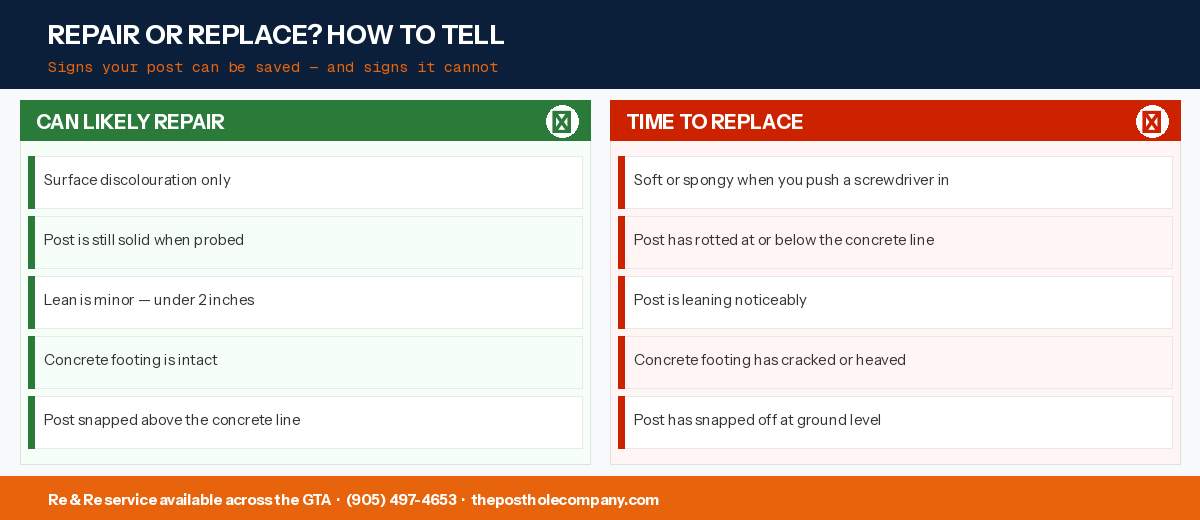
A leaning or soft post doesn’t always mean replacing the entire fence section. But knowing when you can repair and when you need to replace saves you from throwing good money after bad.
You can likely repair when:
- The post is still solid when you push a screwdriver firmly into it — no soft spots
- The lean is minor and the footing is still intact underground
- The visible damage is surface discolouration rather than structural softness
- The post snapped above the concrete line — in some cases a sister post can be installed
It’s time to replace when:
- The post is soft or spongy at or below grade — the rot has reached structural wood
- The post has snapped off at or below the concrete line
- The concrete footing itself has cracked, heaved, or is no longer holding
- The post is leaning noticeably and the underlying footing is the problem
If you’re in the second category, the right fix is a full Re & Re — remove the old post and concrete footing, dig fresh to proper depth, set a new post, and pour new concrete. Done correctly, a Re & Re restores the fence to full strength and you won’t be back at the same post in two years.
We handle Re & Re work across the GTA — one visit, panels taken down and rehung while the concrete is wet for a tight fit. Read more about how our Re & Re service works in our Post Removal and Re & Re post.
Ready to Book a RE & RE?
If you’ve got a post that’s rotted, leaning, or snapped, we can help. We serve residential and commercial clients across Mississauga, Burlington, Hamilton, Brampton, Oakville, Scarborough, and the greater GTA.
📞 Call us at (905) 497-4653 💬 Message us on WhatsApp 🌐 See our full pricing online 📅 Request a quote